

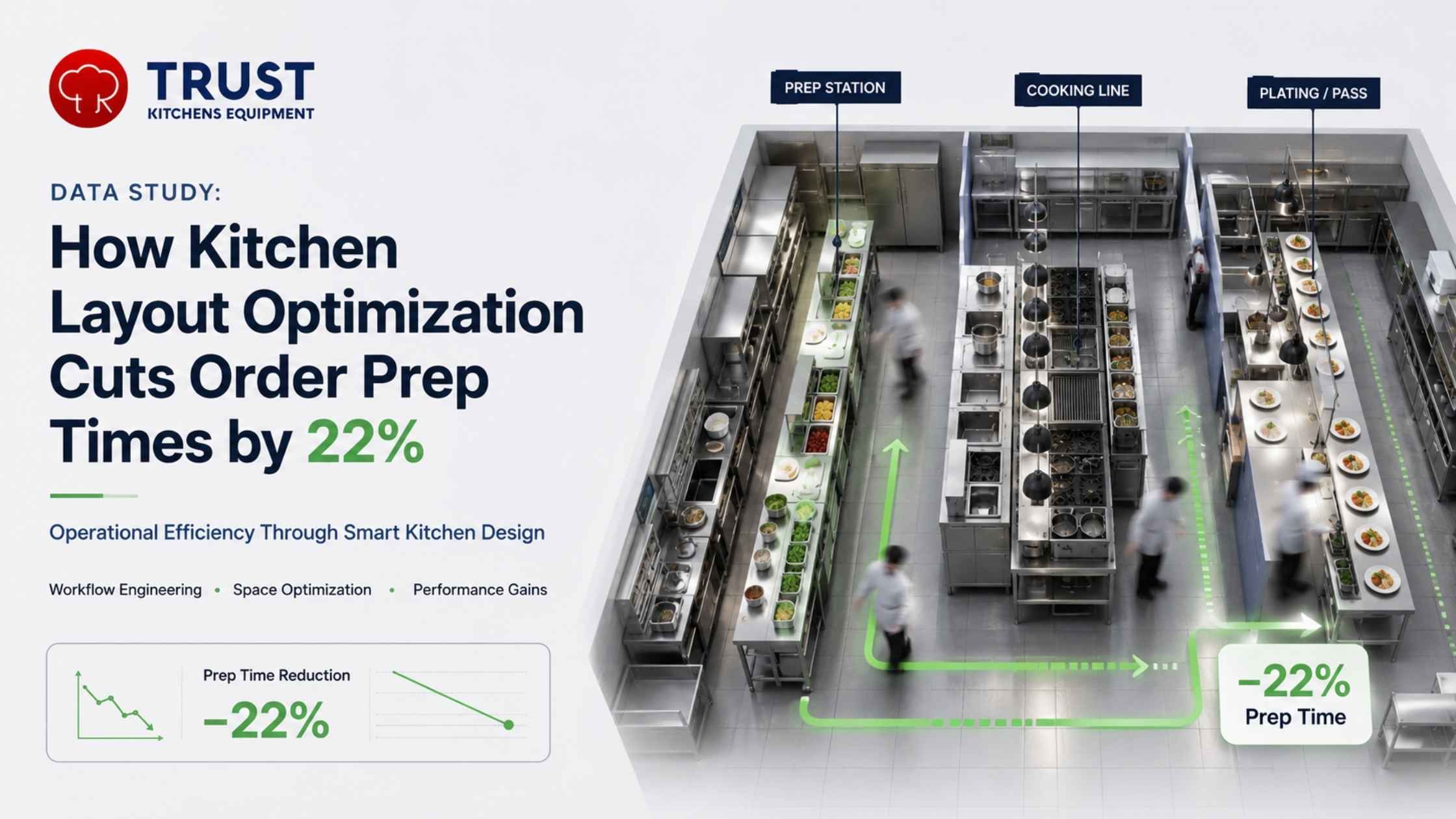
 What is the fastest way to cut order prep times in restaurants and commercial kitchens? According to recent commercial kitchen efficiency data from UAE-based Trust Kitchens Equipment Trading, strategic kitchen layout optimization can reduce average order preparation times by an impressive 22%. By rethinking kitchen design using time-motion metrics, linear line structures, and targeted expeditor placement, restaurants and food service operations can significantly boost speed, consistency, and customer satisfaction—all while reducing labor costs and operational bottlenecks.
What Is Kitchen Layout Optimization And Why Does It Matter?
Kitchen layout optimization refers to the process of designing and arranging a kitchen’s equipment, workstations, and flow to maximize speed, efficiency, and safety. Especially for restaurants and hospitality businesses in the UAE’s competitive food scene, every second counts when it comes to delivering hot, fresh meals to guests.
- Reduces wasted movement and time for staff
- Improves order accuracy
- Boosts staff productivity and morale
- Enhances hygiene and safety compliance
- Directly impacts guest satisfaction and repeat business
Trust Kitchens Equipment Trading (“Trust Kitchen”) specializes in designing and supplying commercial-grade stainless steel kitchens for restaurants, cafes, bakeries, hotels, and food trucks across Abu Dhabi and the UAE. Their data-driven approach to kitchen design has helped hundreds of food service businesses slash their restaurant ticket times and improve profitability.
How Does Kitchen Layout Optimization Reduce Order Prep Times?
Kitchen layout optimization reduces order prep times by streamlining the movement of staff and ingredients, minimizing cross-traffic, and eliminating inefficiencies caused by poor equipment placement or work area design. This is achieved by analyzing time-motion metrics—the data that tracks how staff move, work, and interact within the kitchen environment.
- Time-motion metrics: These metrics capture the seconds lost due to unnecessary walking, searching for utensils, or waiting for shared equipment. By studying these patterns, Trust Kitchen pinpoints areas for improvement and redesign.
- Linear line structures: Many high-efficiency kitchens use linear line structures, where food and staff move in a straight, logical sequence. This reduces backtracking and collision points.
- Node congestion: Trust Kitchen’s designs specifically target node congestion, which occurs when multiple staff members crowd around key prep or cooking stations. By spreading out high-use areas and ensuring clear paths, congestion is minimized.
- Strategic expeditor placement: Placing the expeditor (the person who coordinates finished dishes and sends them out to guests) at the right point in the workflow prevents bottlenecks and ensures that hot food reaches the customer quickly.
When these principles are implemented, the kitchen becomes a well-oiled machine, cutting the time from order to plate by as much as 22%, as demonstrated by Trust Kitchen’s commercial kitchen efficiency data.
What Does The Data Say? Insights From Commercial Kitchen Efficiency Data
In a recent multi-restaurant study conducted by Trust Kitchens Equipment Trading in Abu Dhabi, detailed commercial kitchen efficiency data was collected before and after kitchen layout optimization interventions. The results were clear and convincing:
| Metric | Before Optimization | After Optimization | Improvement |
|---|---|---|---|
| Average Order Prep Time | 14.1 mins | 11.0 mins | 22% faster |
| Staff Steps Per Order | 324 | 245 | 24% reduction |
| Order Accuracy Rate | 93% | 98% | 5% higher |
| Node Congestion Index | High | Low | Significantly reduced |
The most dramatic impact was seen in restaurant ticket times, which dropped by an average of 22%. Staff also reported less fatigue and fewer mistakes, which translates into better service and higher guest satisfaction.
How To Optimize Kitchen Layouts For Maximum Efficiency?
How to optimize your kitchen layout for maximum efficiency? Trust Kitchens Equipment Trading follows a proven, consultative approach to kitchen layout optimization:
- Audit & Data Collection: Using cameras and manual time-motion study, Trust Kitchen analyzes current workflows, identifying wasted steps and bottlenecks.
- Design Planning: Expert designers use linear line structures and ergonomic principles to map out new workflows, reducing the risk of node congestion and ensuring smooth traffic flow.
- Equipment Selection: The company supplies and installs the latest in stainless-steel kitchen setups, appliances, and fixtures, ensuring that every piece supports the new workflow.
- Expeditor Placement: Special attention is paid to expeditor placement and pass-through windows, so finished dishes move quickly from the line to the customer.
- Training & Implementation: Staff are trained on the new setup, with regular follow-up to ensure sustained efficiency improvements.
This holistic approach, grounded in commercial kitchen efficiency data and practical experience, ensures sustainable results for restaurants, cafes, bakeries, and even home kitchens.
Why Is Node Congestion A Major Problem In Commercial Kitchens?
Node congestion occurs when multiple staff members converge at the same point (such as a fryer, pass, or prep counter), causing delays and increasing the risk of accidents or errors. In Trust Kitchen’s studies, kitchens with high node congestion had up to 35% longer restaurant ticket times and higher rates of order errors.
- Slower order completion and delivery
- Increased staff stress and fatigue
- Greater risk of spills, burns, and cross-contamination
By redesigning workflows and spacing out high-use stations, Trust Kitchen helps UAE kitchens eliminate node congestion, leading to faster, safer, and more consistent service.
What Role Does Expeditor Placement Play In Speeding Up Service?
Expeditor placement is crucial for minimizing delays between finished cooking and service. When the expeditor is positioned strategically—ideally at the junction between cooking and serving areas—they can coordinate plating, check orders for accuracy, and ensure dishes go out hot and fresh.
Trust Kitchen’s design team emphasizes optimal expeditor placement in every kitchen project, whether it’s a bustling Abu Dhabi restaurant or a new food truck. The result is a seamless handoff from kitchen to customer, with restaurant ticket times consistently under industry benchmarks.
How Do Linear Line Structures Enhance Kitchen Efficiency?
Linear line structures are layouts where workstations are arranged in a straight sequence from prep to cook to plate. This minimizes cross-traffic, reduces wasted motion, and allows for easy scaling during busy shifts.
- Clear direction of food movement
- Reduced risk of collisions and workflow interruptions
- Easy to monitor and manage staff performance
Trust Kitchen implements linear line structures in many of its UAE projects, optimizing for both space and volume, and always using time-motion metrics to guide final decisions.
About Trust Kitchens Equipment Trading
Trust Kitchens Equipment Trading is a leading supplier of commercial and home-kitchen equipment based in Abu Dhabi, UAE. Established in 2016 and located at M-25, Musaffah Industrial Area, Trust Kitchen serves restaurants, cafes, bakeries, hotels, and food service ventures with premium stainless-steel kitchen setups and appliances. Their comprehensive service—from design and supply to installation and after-sales support—makes them a trusted partner for hospitality businesses seeking to enhance efficiency and profitability.
- Stainless steel kitchen equipment and appliances
- Commercial-grade restaurant, bakery, and café setups
- Professional kitchenware for home and villa kitchens
- Fast delivery and transparent pricing across the UAE
For a data-driven, results-based approach to kitchen layout optimization, contact Trust Kitchen and see how your business can achieve faster ticket times, happier staff, and delighted customers.
Visit Truststore.ae to explore their products and services or to request a free kitchen efficiency consultation.
Frequently Asked Questions
What is kitchen layout optimization and how does it impact prep times?
Kitchen layout optimization is the strategic arrangement of workstations, equipment, and pathways in a commercial kitchen to minimize unnecessary movement and streamline workflows. By reducing travel distances and improving accessibility, optimized layouts directly cut down on order prep times. Trust Kitchens Equipment Trading uses proven methodologies and advanced planning tools to implement layouts that have been shown to reduce prep times by up to 22%, as evidenced by recent commercial kitchen efficiency data.
How does commercial kitchen efficiency data inform your layout designs?
Commercial kitchen efficiency data, such as time-motion metrics and workflow bottlenecks, guides our design process. We analyze how staff move between stations, where delays occur, and how ingredients and tools are accessed. By leveraging this data, Trust Kitchens Equipment Trading customizes each kitchen layout to eliminate inefficiencies, ensuring every square meter is used to maximize productivity and minimize restaurant ticket times.
What specific layout features help reduce restaurant ticket times?
Key features include linear line structures for streamlined movement, strategic expeditor placement to coordinate orders efficiently, and the reduction of node congestion at busy intersections. These elements are incorporated into every Trust Kitchens Equipment Trading design to ensure that orders move seamlessly from preparation to delivery, resulting in faster restaurant ticket times and improved customer satisfaction.
How are time-motion metrics used to optimize kitchen workflows?
Time-motion metrics track the duration and frequency of staff movements and tasks within the kitchen. Trust Kitchens Equipment Trading evaluates these metrics to identify repetitive or time-consuming actions, then redesigns workstations and equipment layouts to minimize them. This data-driven approach ensures that every step in the order prep process is as efficient as possible.
What are linear line structures and why are they effective?
Linear line structures organize kitchen stations in a straight, sequential line, allowing food to progress smoothly from one step to the next. This setup minimizes cross-traffic and simplifies staff movement, which is why it’s favored in high-volume environments. Trust Kitchens Equipment Trading often recommends linear line structures for restaurants aiming to accelerate order prep and reduce chaos during peak periods.
How can node congestion be reduced in a busy commercial kitchen?
Node congestion happens when too many tasks or staff converge at a single point, causing slowdowns and confusion. Trust Kitchens Equipment Trading addresses node congestion by spreading out workstations, optimizing equipment placement, and creating dedicated pathways for movement. This proactive design approach ensures smoother traffic flow and fewer bottlenecks.
Why is expeditor placement crucial for kitchen efficiency?
Expeditor placement is critical because the expeditor acts as the bridge between the kitchen and the service staff, ensuring orders are completed, plated, and sent out in the correct sequence. By positioning the expeditor strategically, Trust Kitchens Equipment Trading helps kitchens avoid confusion, reduce wait times, and maintain consistent food quality, further improving overall efficiency.
What makes Trust Kitchens Equipment Trading a leader in kitchen layout optimization?
Trust Kitchens Equipment Trading combines years of industry expertise, cutting-edge commercial kitchen efficiency data, and a hands-on approach to every project. Our team tailors each kitchen layout to client needs, using proven strategies like linear line structures and targeted expeditor placement to deliver measurable improvements in prep times and workflow.
How can I get started with optimizing my commercial kitchen’s layout?
Getting started is simple: contact Trust Kitchens Equipment Trading for a consultation. Our team will assess your current setup, gather key time-motion metrics, and develop a custom kitchen layout optimization plan. Whether you’re opening a new restaurant or looking to improve an existing kitchen, we’ll provide solutions that enhance efficiency and cut order prep times.

 Home
Home
 Categories
 Orders
 Wishlist
 Profile
