

Choosing the right ventilation system is critical for any professional kitchen. Among the most important decisions operators must make is selecting between different commercial kitchen hood types. In professional kitchens across the UAE, the choice between a ducted vs ductless hood can significantly influence safety, compliance, installation cost, and kitchen efficiency.
Commercial kitchens generate heat, grease particles, smoke, and odors during cooking. Without proper ventilation, these pollutants accumulate, affecting air quality, safety, and hygiene standards. Modern kitchen ventilation systems uae are designed to remove airborne contaminants efficiently while maintaining a comfortable working environment.
Businesses launching restaurants, bakeries, cafés, or food trucks often rely on experienced suppliers like Trust Kitchens Equipment Trading to identify the correct hood systems and ensure safe installation. Their expertise in stainless-steel commercial kitchens and ventilation equipment helps hospitality businesses across the UAE operate safely while meeting regulatory standards.
What are commercial kitchen hood types?
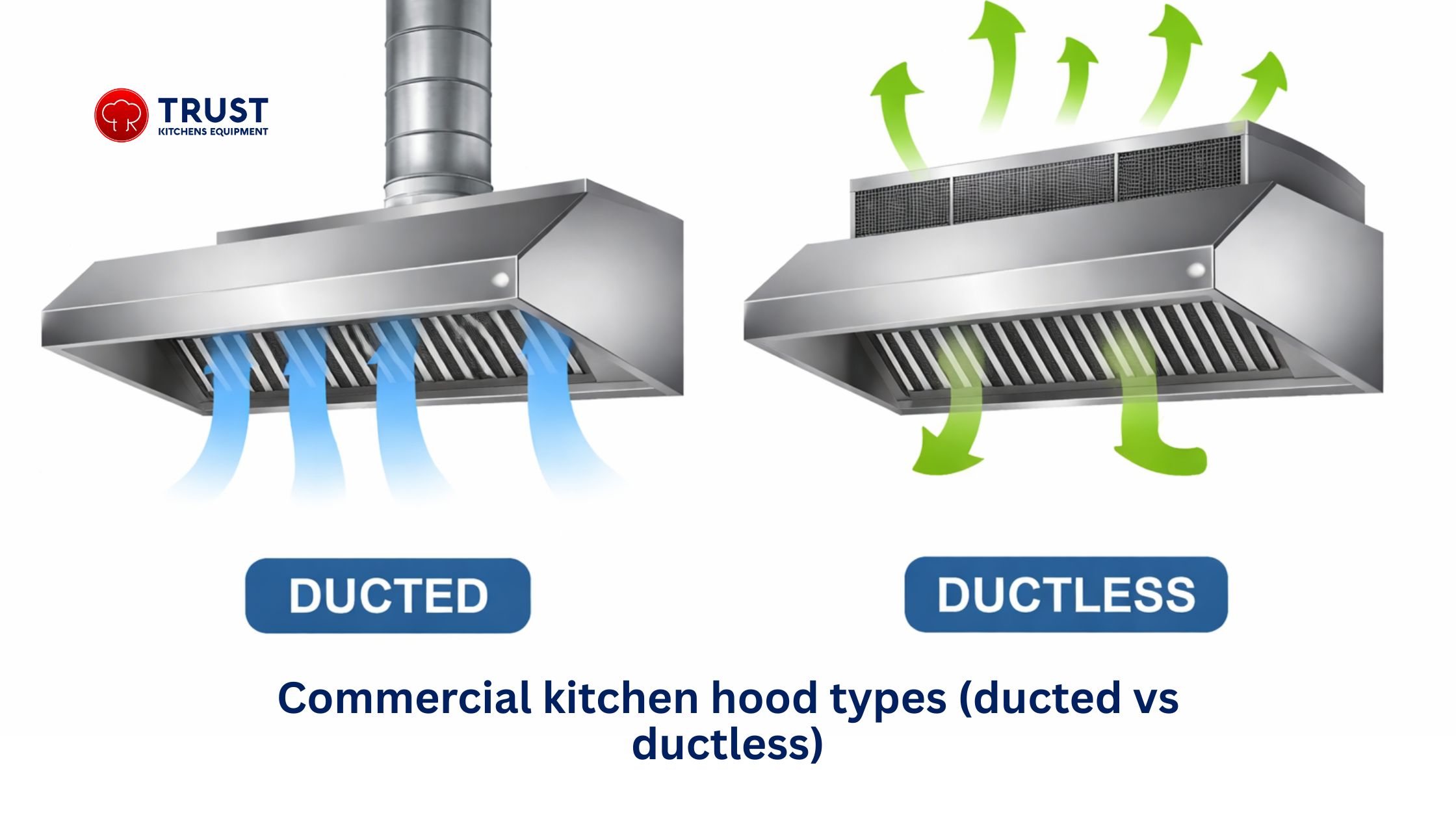
Commercial kitchen hood types refer to ventilation structures installed above cooking equipment to capture grease, smoke, steam, and heat produced during cooking. These hoods direct contaminated air through filters and either expel it outdoors or clean and recirculate it back into the kitchen.
The two most widely used systems in restaurants and food establishments are:
- Ducted ventilation systems that channel air outside the building.
- Ductless ventilation systems that filter and recirculate air within the kitchen.
Understanding the difference between these systems helps operators select the most appropriate option for their kitchen layout and cooking intensity.
Ducted vs ductless hood: Understanding the key difference
The comparison between a ducted vs ductless hood primarily comes down to how air is handled after contaminants are captured.
| Feature | Ducted Hood | Ductless Hood |
| Airflow direction | Air is vented outside the building | Air is filtered and recirculated |
| Installation complexity | Requires ductwork and roof access | Simpler installation |
| Efficiency | Higher for heavy cooking operations | Suitable for light cooking |
| Maintenance | Requires duct cleaning | Requires frequent filter replacement |
| Typical use | Restaurants, hotels, commercial kitchens | Food kiosks, small kitchens, food trucks |
Both systems serve different operational needs, and selecting the correct option depends on cooking volume, kitchen size, and building regulations.
Why are kitchen ventilation systems uae essential for restaurants?
High-quality kitchen ventilation systems uae are essential for maintaining hygiene, safety, and regulatory compliance in professional kitchens. UAE authorities require proper ventilation to ensure food establishments meet strict safety standards.
Proper ventilation provides multiple benefits:
- Removes grease particles and smoke
- Reduces kitchen temperature and improves comfort
- Prevents grease accumulation in walls and ceilings
- Improves indoor air quality
- Reduces fire risks
Restaurants and bakeries rely on well-designed restaurant hood systems uae to protect employees and maintain safe cooking environments.
Common exhaust hood types uae used in commercial kitchens
Professional kitchens across the UAE typically install several exhaust hood types uae depending on their cooking setup and kitchen layout.
Wall-mounted exhaust hood
A wall mounted kitchen hood uae is installed directly against a wall above cooking appliances such as grills, fryers, and ranges. These hoods are commonly used in restaurant kitchens where cooking equipment is aligned along the wall.
Advantages include:
- Efficient smoke and grease capture
- Easy installation
- Cost-effective ventilation solution
Island canopy hood
This hood is suspended from the ceiling and placed above cooking equipment positioned in the center of the kitchen.
It is commonly used in:
- Large restaurants
- Hotel kitchens
- Open kitchen layouts
Proximity hood systems
Proximity hoods are installed closer to cooking appliances, capturing contaminants before they disperse into the kitchen.
These systems are particularly useful in compact kitchens or food trucks.
How grease filter types impact ventilation performance
The effectiveness of commercial kitchen hoods depends heavily on the quality of grease filter types installed within the system.
Grease filters capture airborne grease particles before air enters ducts or filtration chambers.
Common filter types include:
- Baffle filters – Stainless steel filters that force grease to change direction and collect in drainage channels.
- Mesh filters – Lightweight filters used in lighter cooking environments.
- Cartridge filters – High-efficiency filters used in advanced ventilation systems.
Professional kitchens prefer stainless steel baffle filters because they are durable, easy to clean, and meet commercial fire safety standards.
How airflow calculation kitchen determines hood efficiency
Proper ventilation design requires accurate airflow calculation kitchen. Airflow calculations determine how much air must be extracted to effectively remove heat, smoke, and grease.
Ventilation engineers typically calculate airflow using factors such as:
- Cooking equipment heat output
- Hood size
- Kitchen layout
- Cooking intensity
- Duct length
Airflow is usually measured in cubic feet per minute (CFM). Larger kitchens with heavy cooking operations require higher airflow capacity to maintain proper ventilation.
Professional suppliers like Trust Kitchens Equipment Trading help restaurant owners select hood systems with the appropriate airflow capacity for their kitchen operations.
Commercial hood installation: Key steps for restaurants
Proper commercial hood installation ensures safe operation, efficient ventilation, and compliance with fire safety standards.
Typical installation steps include:
- Kitchen layout assessment
- Selection of suitable hood type
- Ductwork planning and routing
- Installation of grease filters and exhaust fans
- Electrical and airflow testing
- Compliance inspection
Incorrect installation can lead to ventilation inefficiency, excessive grease buildup, and potential fire hazards. For this reason, restaurants often rely on experienced kitchen equipment suppliers and installers.
Restaurant hood systems uae for different food businesses
Different food businesses require different types of restaurant hood systems uae. The ventilation needs of a bakery, café, or grill restaurant vary significantly.
Examples include:
- Restaurants with grills and fryers – Require high-capacity ducted exhaust systems.
- Cafés with light cooking – May use compact hood systems.
- Bakeries – Need systems capable of handling heat from ovens.
- Food trucks – Often use compact ductless systems due to space limitations.
Choosing the correct system ensures operational efficiency while maintaining air quality and safety.
How to choose between ducted vs ductless hood systems
Selecting between a ducted vs ductless hood depends on several operational and structural factors.
Restaurant owners should consider:
- Cooking intensity and equipment type
- Kitchen layout and available ceiling space
- Local building regulations
- Maintenance requirements
- Installation cost and timeline
Heavy-duty kitchens almost always require ducted systems, while small operations may benefit from ductless units.
About Trust Kitchens Equipment Trading
Trust Kitchens Equipment Trading is a commercial kitchen equipment supplier based in Musaffah Industrial Area, Abu Dhabi, UAE. Established in 2016, the company provides professional-grade kitchen equipment, stainless steel kitchen setups, restaurant appliances, and ventilation systems for hospitality businesses across the UAE.
The company serves restaurants, cafés, bakeries, hotels, catering units, and food-service entrepreneurs by offering durable equipment designed to meet commercial standards. Through its online platform Truststore.ae, businesses across the UAE can easily source equipment ranging from cooking appliances to complete kitchen setups.
Trust Kitchens Equipment Trading focuses on delivering quality, affordability, and reliable service, helping food-service entrepreneurs establish professional kitchens that meet industry requirements.
Conclusion
Choosing between different commercial kitchen hood types is a crucial step in building a safe and efficient commercial kitchen. Whether selecting a ducted ventilation system or evaluating a ducted vs ductless hood, restaurant owners must consider airflow requirements, kitchen layout, and cooking intensity.
Modern kitchen ventilation systems uae play a critical role in maintaining air quality, reducing fire risks, and improving working conditions in professional kitchens. By working with experienced suppliers such as Trust Kitchens Equipment Trading, businesses can ensure proper system selection, reliable commercial hood installation, and long-term ventilation performance.

 Home
Home
 Categories
 Orders
 Wishlist
 Profile
