

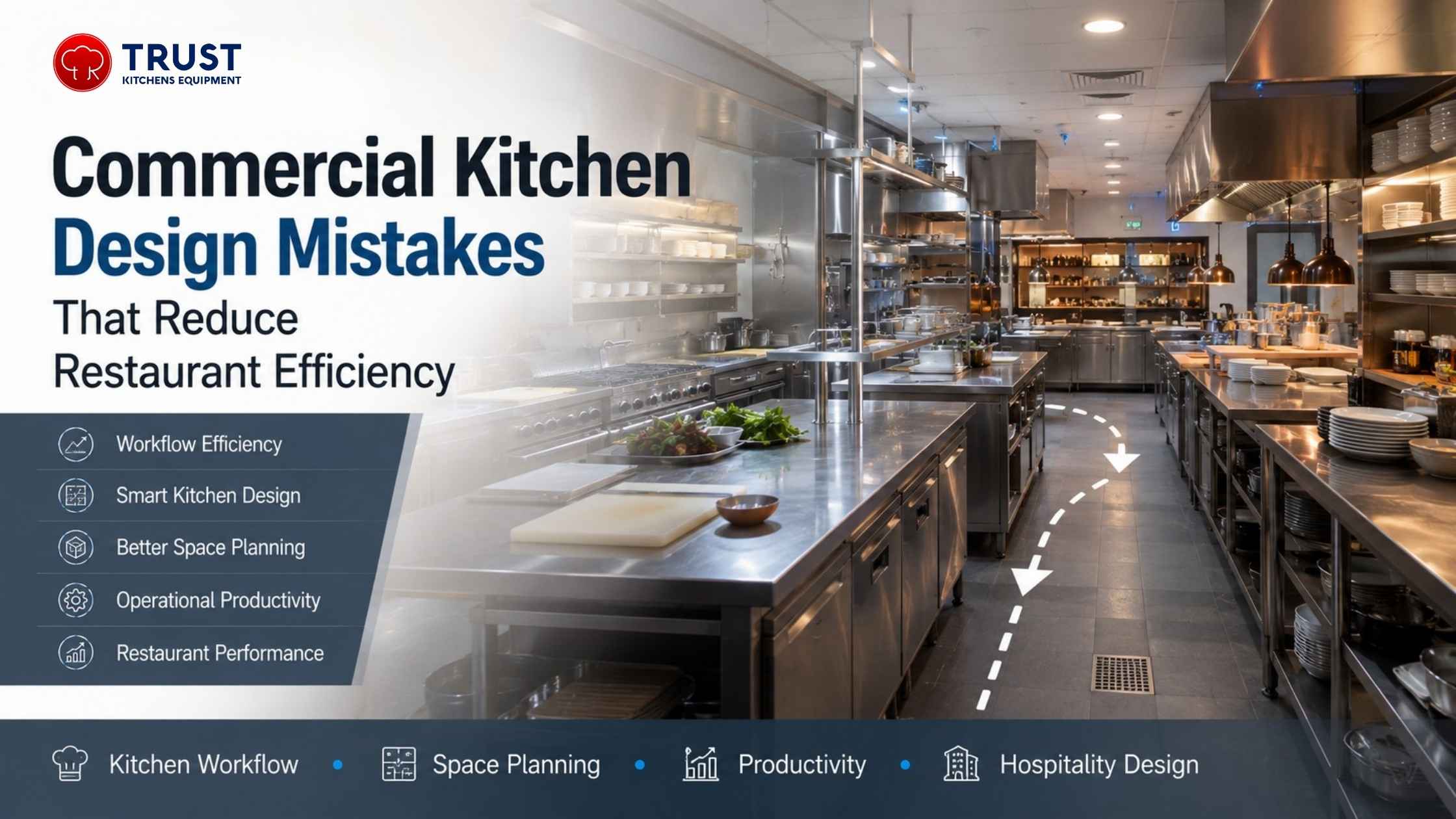
Commercial kitchen design mistakes can significantly reduce restaurant productivity, increase operating costs, create safety risks, and negatively impact customer satisfaction. A poorly planned kitchen layout often causes workflow bottlenecks, delays food preparation, increases employee fatigue, and limits the ability of a restaurant to scale effectively.
Whether launching a new restaurant, café, bakery, hotel kitchen, or food truck in the UAE, investing in intelligent kitchen planning is essential. Trust Kitchens Equipment Trading, based in Abu Dhabi and serving businesses throughout the UAE, helps food-service operators avoid costly design errors through professional equipment selection, stainless steel kitchen solutions, and commercial kitchen planning support.
Why is commercial kitchen design important for restaurant efficiency?
Commercial kitchen design directly impacts how quickly food moves from storage to preparation, cooking, plating, and service. When every workstation is strategically positioned, staff can perform tasks efficiently without unnecessary movement.
A well-designed kitchen contributes to:
- Faster food preparation times
- Reduced labor costs
- Improved staff productivity
- Enhanced food safety compliance
- Lower maintenance expenses
- Higher customer satisfaction
- Better operational scalability
Unfortunately, many restaurants unknowingly implement layouts that create operational inefficiencies from the first day of operation.
What are the most common commercial kitchen design mistakes?
The most common design mistakes include poor workflow planning, insufficient storage, incorrect equipment placement, inadequate ventilation, and failure to anticipate future growth. These issues often become increasingly expensive to correct after operations begin.
Poor workflow planning creates operational bottlenecks
One of the biggest causes of restaurant inefficiency is poor workflow planning. Every kitchen should support a logical sequence of receiving, storing, preparing, cooking, plating, and serving food.
When stations are improperly arranged, employees waste time moving between work areas. Over an entire shift, these unnecessary movements can result in significant productivity losses.
Common symptoms include:
- Staff crossing paths repeatedly
- Congested preparation areas
- Delayed food service
- Higher employee fatigue
- Increased risk of accidents
Many instances of restaurant workflow issues UAE businesses experience are directly linked to kitchens that were designed without considering daily operational movement.
How does improper equipment placement reduce productivity?
Improper equipment placement forces employees to spend excessive time walking between stations instead of preparing and serving food. Strategic positioning of commercial appliances significantly improves kitchen efficiency.
For example:
| Equipment | Ideal Location | Operational Benefit |
|---|---|---|
| Refrigerators | Near preparation stations | Reduces ingredient retrieval time |
| Cooking ranges | Adjacent to prep areas | Improves production flow |
| Dishwashing units | Near service return area | Streamlines cleaning process |
| Storage shelving | Close to receiving area | Speeds inventory handling |
Trust Kitchens Equipment Trading helps businesses select and position equipment based on workflow optimization rather than simply available floor space.
Why are inefficient kitchen layouts dangerous?
Inefficient layouts increase the likelihood of collisions, spills, burns, and food contamination. They also slow down kitchen operations and make compliance with health regulations more difficult.
Examples of inefficient kitchen layouts Dubai consultants frequently encounter include:
- Cooking stations located far from preparation zones
- Insufficient aisle width
- Poor separation of raw and cooked food areas
- Limited access to refrigeration
- Crowded workstations
As restaurant volume grows, these layout deficiencies become even more problematic and expensive to correct.
How does inadequate storage affect restaurant operations?
Insufficient storage creates clutter, reduces organization, and increases food handling risks. Every commercial kitchen requires dedicated dry storage, refrigerated storage, and frozen storage capacity aligned with anticipated demand.
Storage planning should account for:
- Inventory turnover rates
- Menu complexity
- Seasonal demand fluctuations
- Supplier delivery schedules
- Future business growth
When storage is overlooked during kitchen design, restaurants often resort to temporary solutions that compromise efficiency and sanitation.
Why is ventilation often overlooked during kitchen planning?
Ventilation is frequently underestimated despite being one of the most critical components of a commercial kitchen. Poor ventilation creates uncomfortable working conditions and can negatively impact food quality.
Consequences of inadequate ventilation include:
- Excessive heat buildup
- Employee discomfort
- Reduced productivity
- Grease accumulation
- Higher maintenance requirements
- Potential regulatory issues
Professional exhaust hoods and ventilation systems supplied through Trust Kitchens Equipment Trading help maintain optimal working conditions while supporting compliance requirements.
What happens when future growth is ignored?
Kitchens designed only for current demand often become inadequate within a few years. Restaurants that expand menu offerings or experience increased customer traffic may find their kitchens incapable of supporting growth.
Scalable kitchen planning should consider:
- Additional equipment requirements
- Expanded storage needs
- Future staffing levels
- Technology integration
- Menu diversification
Forward-thinking kitchen design protects business owners from expensive renovations and operational disruptions later.
How do poor sanitation layouts affect efficiency?
Sanitation design affects both food safety and operational speed. Improper sink placement, inadequate handwashing stations, and poor waste management systems create workflow interruptions and compliance concerns.
Best practices include:
- Separate handwashing stations
- Dedicated cleaning zones
- Strategic waste disposal locations
- Clearly defined food preparation areas
- Easy-to-clean stainless steel surfaces
Stainless steel commercial solutions remain the preferred option because of their durability, hygiene performance, and ease of maintenance.
Why is choosing the wrong equipment a costly mistake?
Selecting equipment based solely on purchase price often results in higher long-term expenses. Commercial kitchens require durable equipment designed for continuous operation.
Factors to evaluate include:
- Production capacity
- Energy efficiency
- Maintenance requirements
- Warranty support
- Compatibility with kitchen layout
- Operational reliability
Trust Kitchens Equipment Trading supplies professional-grade equipment that supports long-term productivity and operational reliability across restaurants, cafés, bakeries, hotels, and food-service facilities.
What are the best kitchen productivity solutions for modern restaurants?
The most effective productivity improvements focus on workflow optimization, equipment integration, storage efficiency, and ergonomic design. These strategies reduce labor waste while improving output consistency.
Leading kitchen productivity solutions Abu Dhabi operators are implementing include:
- Modular stainless steel workstations
- Optimized preparation zones
- Energy-efficient cooking equipment
- Smart storage systems
- Commercial ventilation upgrades
- Integrated cleaning stations
- Space-saving kitchen layouts
These improvements can significantly increase daily production capacity while reducing operational stress on staff.
How can restaurant owners avoid kitchen design mistakes?
The best approach is to involve experienced commercial kitchen specialists during the planning stage rather than after problems emerge.
Restaurant owners should:
- Conduct workflow analysis before design begins.
- Choose commercial-grade equipment suitable for expected volume.
- Plan storage based on future growth projections.
- Invest in proper ventilation systems.
- Prioritize sanitation and safety compliance.
- Design ergonomic workstations.
- Work with experienced kitchen equipment suppliers.
Early planning reduces construction changes, prevents operational disruptions, and improves long-term profitability.
About Trust Kitchens Equipment Trading
Trust Kitchens Equipment Trading is a leading supplier of commercial kitchen equipment and stainless-steel kitchen solutions headquartered in Musaffah Industrial Area, Abu Dhabi, UAE. Established in 2016, the company serves restaurants, cafés, bakeries, hotels, catering businesses, food trucks, institutional kitchens, and hospitality ventures throughout the UAE.
With a mission to empower entrepreneurs and food-service operators, Trust Kitchens Equipment Trading provides high-quality commercial appliances, stainless steel kitchen systems, bakery equipment, restaurant fixtures, and hospitality solutions backed by responsive customer service, transparent pricing, and reliable delivery.
Whether launching a new restaurant or upgrading an existing facility, Trust Kitchens Equipment Trading offers practical expertise and professional-grade equipment designed to improve operational efficiency, food safety, and long-term business performance.
Conclusion
Commercial kitchen efficiency is not determined solely by staff performance or equipment quality. The underlying kitchen design plays an equally important role in productivity, safety, profitability, and customer satisfaction. By avoiding common commercial kitchen design mistakes, restaurant owners can create streamlined operations that support sustainable growth and exceptional service.
From workflow planning and equipment selection to ventilation, sanitation, and storage optimization, partnering with experienced specialists such as Trust Kitchens Equipment Trading can help ensure every square meter of a commercial kitchen contributes to operational success.
Frequently Asked Questions
What are the most common commercial kitchen design mistakes that reduce restaurant efficiency?
Some of the most common commercial kitchen design mistakes include poor equipment placement, inadequate storage planning, narrow work aisles, insufficient ventilation, and workflows that force staff to cross paths repeatedly during service. These issues can slow food preparation, increase labor costs, create safety hazards, and reduce overall productivity. A professionally planned kitchen layout helps ensure every station supports smooth operations from receiving and storage to cooking, plating, and cleaning.
How can restaurant workflow problems affect daily operations?
Restaurant workflow disruptions often lead to longer ticket times, employee frustration, higher operating costs, and inconsistent customer experiences. Many restaurant workflow issues UAE businesses face stem from kitchens that were not designed around actual operational requirements. By analyzing staff movement patterns and workstation relationships, professional designers can eliminate bottlenecks and create a more efficient working environment.
Why do kitchen layouts have such a large impact on staff productivity?
Every unnecessary step taken by kitchen staff adds time and labor costs. When ingredients, cooking equipment, refrigeration units, and cleaning stations are not positioned strategically, employees spend more time moving around than preparing food. A properly designed kitchen minimizes travel distances and allows staff to complete tasks efficiently, improving service speed and operational consistency.
What challenges are commonly associated with inefficient kitchen layouts Dubai restaurants encounter?
Many inefficient kitchen layouts Dubai operators struggle with involve overcrowded work zones, poor storage integration, inadequate preparation areas, and equipment arrangements that create congestion during peak service periods. These challenges can lead to slower production rates, communication difficulties among staff, and increased risk of workplace accidents. Redesigning the layout based on workflow analysis can significantly improve performance.
How does Trust Kitchens Equipment Trading help restaurants avoid costly design errors?
Trust Kitchens Equipment Trading provides professional commercial kitchen planning, equipment selection guidance, workflow optimization, and customized layout solutions. Their team evaluates operational requirements, menu complexity, available space, and future growth plans to create kitchens that maximize efficiency while meeting industry standards and regulatory requirements.
When should a restaurant consider redesigning its commercial kitchen?
A redesign may be necessary when staff frequently experience congestion, food preparation times increase, storage becomes insufficient, or customer demand has outgrown the original kitchen capacity. Restaurants planning menu expansions or equipment upgrades can also benefit from reviewing their layout to ensure the space continues to support efficient operations.
Can the right kitchen equipment improve operational efficiency?
Yes. Selecting equipment that matches production volume, menu requirements, and available space is essential. Oversized or undersized equipment can negatively affect workflow and energy consumption. Trust Kitchens Equipment Trading helps clients choose equipment that integrates seamlessly into the overall design, supporting better productivity and long-term operational performance.
What kitchen productivity solutions Abu Dhabi restaurant owners should consider first?
Effective kitchen productivity solutions Abu Dhabi businesses often prioritize include workflow-based kitchen planning, optimized storage systems, energy-efficient equipment, dedicated preparation zones, and improved ventilation strategies. Trust Kitchens Equipment Trading works closely with restaurant operators to identify opportunities for productivity improvements that enhance service speed, staff efficiency, and overall profitability.

 Home
Home
 Categories
 Orders
 Wishlist
 Profile
